Recent Posts
Table of Contents
An advisor gets one real shot at making a great impression once a prospect has agreed to become a client. But too often, advisors and their ops team spend that time on paperwork, data collection, and manual administrative work instead of engaging with the person that wants to work with them.
The administrative side is important without a doubt. Clients, though, aren’t thinking about the amount of paperwork or account forms and compliance checks you need to complete.
They’re forming an opinion about what it’s like to work with your firm based entirely on how it feels to cross the bridge from “prospect” to “client.” And if any step in that process feels slow or disjointed, that’s the impression that sticks with them. Fair or not.
Onboarding shouldn’t be treated like a formality. It’s the first real test of whether your firm’s operations and client experience live up to what your advisor talked about during discovery and planning conversations.
What Most Advisors Get Wrong About Digital Onboarding
Most firms with a slow or outdated onboarding experience care greatly about their clients. That care, however, isn’t reflected in their work because of either mistaken beliefs about how the process currently works, or a lack of priority.
In general, firms in this camp have three misconceptions impacting their perception of digital onboarding and its importance.
The first misconception is that “digital” and “automated” mean the same thing.
The industry sometimes still operates in a space where a firm emails a PDF and fills fields by typing, instead of printing, and calls it a digital experience.
Yes, it’s progress over having a client walk into a tall stack of paper sitting on a desk as if they’re about to sign for a new mortgage, but it’s not automation.
When your “digital experience” equates to filling fields in a PDF, someone still has to read what the client filled out and retype it into the CRM. To create a truly modern digital-first experience, eliminating that manual step is critical..
The second misconception is that your custodian’s account-opening tool has you covered.
Custodians are great at many things, but establishing a pure digital account opening process typically isn’t one of them.
The data you collect during account opening and the data living in your CRM stay in two separate databases. Often, the process ends up with different people making updates on different schedules.
When there’s a gap between the information a new client tells you and the time it takes to get it entered (again) into a separate system, that’s where NIGOs and repeated requests for the same information originate.
Neither sets the right tone for someone new to working with you.
The third misconception is timing.
For too many firms, improving the onboard experience is treated as a “nice to have” to complete someday, instead of an essential piece of the client experience that deserves its place in the spotlight right now.
Those firms tend to think they can revisit their onboarding once growth slows down enough to give them time to create a real digital process.
But the truth is, onboarding friction only gets worse as a growing RIA takes on new clients. More households means more manual work, more changes for something to get lost, and less time for the operations team to notice it and fix it before it impacts a client.
Ask any operations staff how they feel about re-typing the same data points into three different systems for every new client, and you’re sure to hear how the “right” time to update a non-automated, non-digital onboarding experience is “right now.”
Why OnBord Is One of the Best Wealthbox Integrations for Client Onboarding
Wealthbox integrations exist to close exactly these kinds of gaps in an advisor’s internal processes, and OnBord was built to do it specifically for onboarding.
OnBord’s integration with Wealthbox isn’t new, but if it’s new to you, here’s what you need to know about how this partnership can make new account opening easier for your team.
Instead of a client filling out a static form that someone later has to enter into your CRM, they get a short, guided digital questionnaire delivered by either text and email—your choice.
As a client enters their responses, that information flows directly into their Wealthbox contact record. No one on your team has to type out a name, an address, a Social Security number, or anything else.
If the client already exists in Wealthbox as a prospect, that information you already have on file can even be pre-filled for them on the new account forms you send through OnBord.
OnBord then uses that same data to fill account-opening documents and internal forms, and it automatically generates the follow-up tasks in Wealthbox your team needs to keep the account moving forward to being open and funded.
The result is that by the time an advisor or client service associate opens Wealthbox to check on a new client, the correct record is already created and the next step is already assigned.
That’s the difference between calling something digital and actually creating an automated digital experience.
The old way of welcoming new clients to your firm relied entirely on your staff; the new way uses the tools and technology you already use and love, and the process runs automatically through them instead.
See the Workflow Live
Reading about a better onboarding workflow can only get you so far. We want you to see how easy it can be with a live walkthrough.
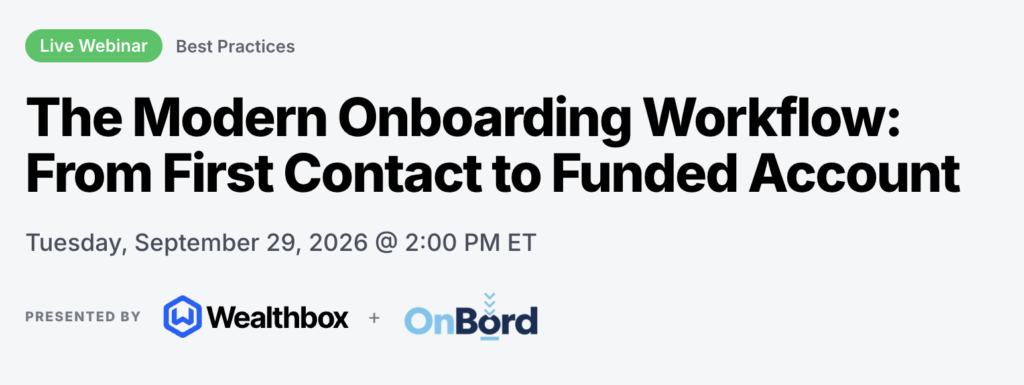
On Tuesday, September 29, 2026, at 2:00 PM ET, OnBord founder Nick Bernardo is joining Christian Kirchoff, Team Lead of Customer Success at Wealthbox, to walk through the entire process live in a free webinar.
If you want to see, step by step, how a Wealthbox integration with OnBord handles onboarding for you, instead of asking you to repeatedly step in and do manual work to keep it moving, then this is a session that you’ll want to experience.